
Artist Resources: From a Research Question to a Usable Result
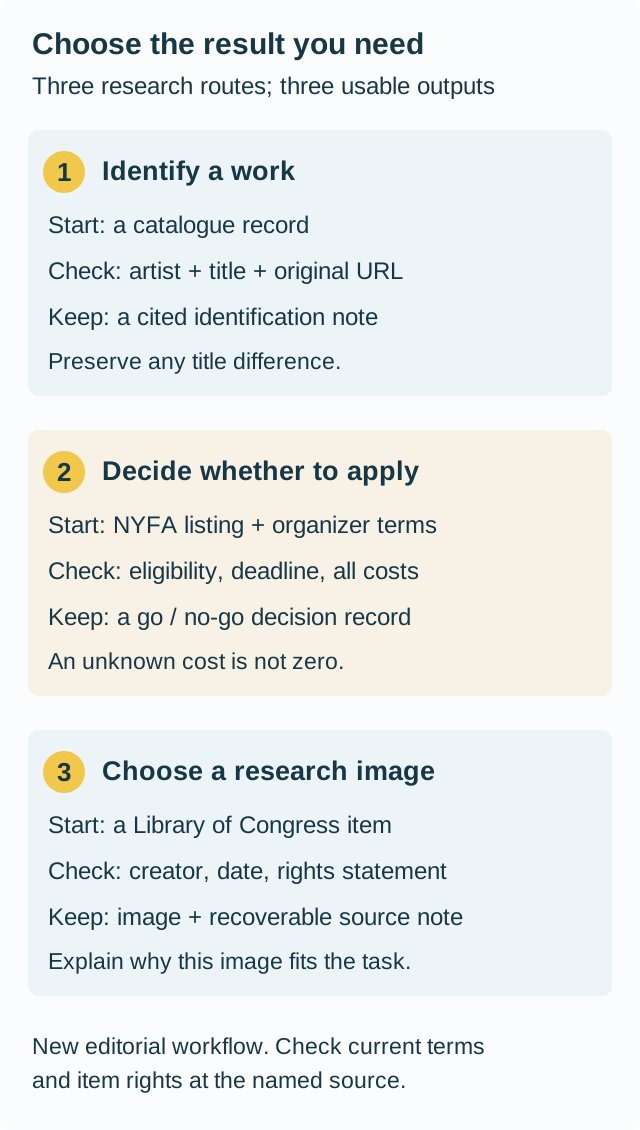
A useful resource ends in something you can use: an identified artwork, a viable application or a documented source image. Start by naming that result. The workflows below separate those tasks so a promising search result does not become a substitute for the information you need.
Sources for three different tasks
The historical Artbrush resources directory, captured in August 2015, grouped links under art history, collections, criticism, teaching, jobs and funding. Today, NYFA’s Artist Opportunities board provides opportunity listings with location, discipline and application-fee filters, including a no-fee option. The Library of Congress’s Free to Use and Reuse page organises selected material into themed sets, including Architecture & Design, Maps of Cities and Travel Posters. Whitney Artport’s Idea Line index supplies artwork records. A historical directory, an application listing, a source collection and a catalogue answer different questions; the task determines which to open first.
Find the work behind a title
Deliverable: one source note connecting a title, artist and original address. Start with the catalogue routes. Locate the work, preserve the catalogue’s title and URL, then compare them with the artist-page evidence. If the names differ, record the difference instead of choosing the one that looks most familiar.
For the museum project, the shared /prix/ address connects the catalogue records to the Welcome to the Met guide despite differing titles. The result is an identification note with evidence, not a claim that every historical page still works.
Decide whether to apply
For an opportunity search, start with NYFA’s location, discipline and application-fee filters, then read the full listing and organiser’s terms. The no-fee choice narrows application fees. It does not settle eligibility or the cost of accepting an offer.
For each candidate, write down the deadline and timezone, location or residency obligation, eligible medium, required files, application fee and other unavoidable costs. Keep the listing URL and organiser URL together. A no-fee application can still require travel, materials or accommodation.
Decision record: eligibility; deadline and timezone; application fee; travel or residency obligation; materials cost; required portfolio files; organiser’s terms. An empty field is a reason to investigate, not a zero cost. A listing earns a place on a shortlist when those fields support an actual decision.
Keep an image and its record together
Deliverable: a documented choice of a photograph and a particular reproduction. Start with a collection’s themed sets, then open the item record. A photograph may have several downloadable versions, each with a different relationship to the original object.
Record the item title, creator if supplied, date, item URL and rights or access statement. Then name the file you selected and why it suits the article. For a discussion of photographic alteration, the relationship between a negative and an earlier print may matter more than the convenience of the largest download.
The result should be a file with a recoverable record, not an anonymous picture in a downloads folder. The completed note below follows one photograph through that choice. Use the reading guide when a work combines several kinds of source material.
A completed source note: one photograph, several files
Selected record: Dorothea Lange’s photograph commonly known as Migrant Mother, Library of Congress item 2017762891. The record dates it March 1936, Nipomo, California. Its archival title begins “Destitute pea pickers in California”.
- Creator and object
- Dorothea Lange, photographer; one 4 × 5 inch nitrate negative.
- Chosen reproduction
- LC-DIG-fsa-8b29516, digital file from the original negative. The item also links distinct print reproductions.
- Rights field
- The item’s Rights Advisory reports no known restrictions; its Rights & Access section identifies the FSA/OWI black-and-white negatives as public domain, free to use and reuse.
- Credit
- Library of Congress, Prints & Photographs Division, Farm Security Administration/Office of War Information Black-and-White Negatives.
- Selection decision
- Selected for a discussion of photographic versions. The record notes retouching of a thumb on the negative and links a print made before that change.
This completes an item-level note without pretending every download from the collection is the same file. No image is republished here. The creator, object, digital reproduction and catalogue record remain distinguishable.
Sources
- NYFA — Artist Opportunities
- Library of Congress — Free to Use and Reuse sets
- Whitney Artport — Idea Line text catalogue
- Historical Artbrush resources directory — capture of 20 August 2015
The decision checklist and image-source note are current editorial guidance. Listing terms and item rights statements must be checked at their sources when used.