
A Garden That Remembers: Kelly Sinnapah Mary’s Living Portraits
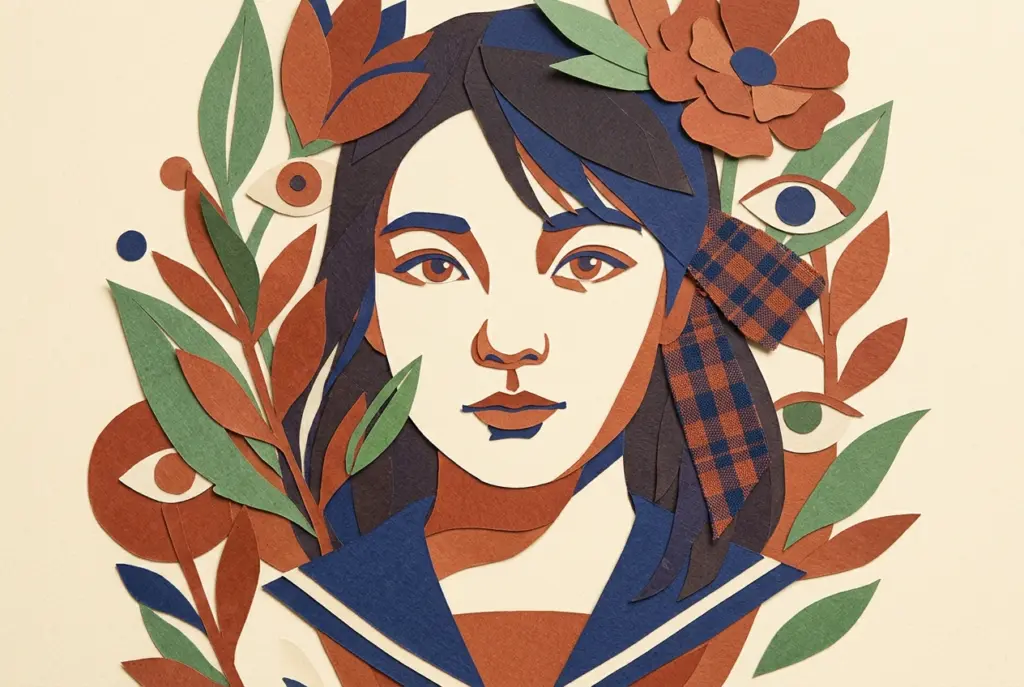
In Violette’s Garden: My Father’s Shoes, flowers with human heads rise from a plaid coverlet. Nearby, a schoolgirl holds a book and pipe, meeting the viewer’s gaze with a third eye. These details refuse a clean division between portrait, garden, and story: the human figure is not simply placed in nature but grows within a world that seems to look back.
Kelly Sinnapah Mary, born in Guadeloupe, builds images in which people, plants, and animals enter a shared, surreal space. The effect is more than decorative abundance. Vegetation becomes a visual language for connection, but also for histories that cannot be reduced to one identity or one origin. The artist’s recurring figure, Sanbras, carries a name derived from a derogatory children’s book popular in the 19th and 20th centuries. Recasting that name as a shifting protagonist makes the figure a site of response: a character who can change across bodies of work rather than remain fixed by an inherited label.
A garden holds more than one history
The Book of Violette takes its name from the artist’s grandmother. In the source account, the series draws on folklore and on the passage of ancestral memory between generations. The garden is especially suggestive in this context. Medicinal plants belong to practical knowledge as well as family recollection; when they appear as human-headed flowers, that knowledge takes an uncanny form. The image does not explain the garden as a symbol with one stable meaning. Instead, it lets memory appear as something embodied, growing, and difficult to separate from the people who carry it.
That complexity also has a historical dimension. The source reports that Sinnapah Mary came to understand her family history as including ancestors who were indentured workers from Tamil Nadu, brought to the Caribbean after slavery’s abolition to replace enslaved labor. This discovery unsettled a narrower account of identity. In the paintings, cultural symbols and family mythology meet without being flattened into a single story. The third eye in Violette’s Garden: My Father’s Shoes, described in the source as a symbol of wisdom and spiritual connection in Hinduism, sits within a composition that also evokes Caribbean family memory. It invites attention to how histories meet, not a claim that they resolve neatly.
Looking beyond the human figure
Sinnapah Mary’s lush settings also challenge the assumption that people stand apart from the living world around them. Foliage can surround the central figure, mark the body, or seem to absorb it. This visual entanglement gives form to questions the source attributes to the artist’s work: how relationships among living beings take shape, and how colonialism and anthropocentrism influence those relationships.
For viewers, a useful way into these paintings is to follow one detail outward. Start with the plaid cloth, the medicinal garden, or the schoolgirl’s gaze; then notice what each detail connects to: domestic memory, inherited knowledge, spiritual reference, or a history of labor and power. The image’s vividness draws the eye in, but its structure keeps that eye moving between bodies, species, and generations.
That movement is the work’s quiet proposition. Ancestral memory is not a sealed archive behind the present; it can surface as a plant, a name, a gaze, or an unexpected conjunction. In these portraits, the garden does not merely frame the person. It helps make the person visible.
Read the source article on Kelly Sinnapah Mary’s portraits and The Book of Violette for its discussion of the paintings and exhibition context.