
Audience and Stage: Six Workshop Resources
A timetable can belong to two routes without becoming two different files. That is the small but consequential choice in this workshop library.
Six resources looking for a home
Consider an invented community printmaking workshop with six resources: a glossary, a packing list, a timetable, a room checklist, a reflection sheet and a materials-return record. The question is how to arrange them for participants and organisers.
Grouping everything by file format gives three folders—PDFs, spreadsheets and text documents—but does not answer “What do I need before arriving?” Grouping only by topic makes the timetable sit beside the room checklist even when a participant needs only one of them. The classification describes the files better than it describes the immediate task.
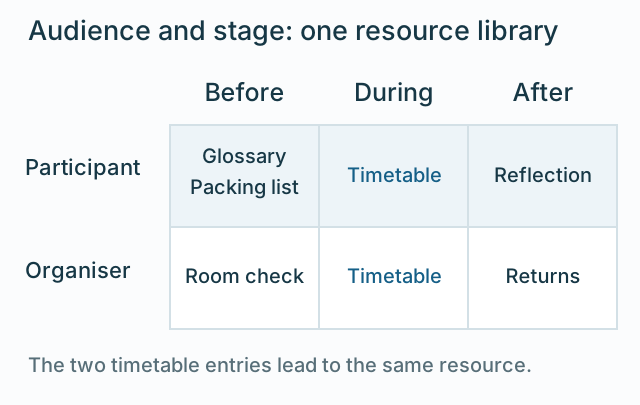
Place every item, then test a second route
- Participant / Before: glossary and packing list.
- Participant / During: timetable.
- Participant / After: reflection sheet.
- Organiser / Before: room checklist.
- Organiser / After: materials-return record.
All six resources now have an initial home. The organiser also needs the timetable during the session. Give that route a link to the same timetable, rather than creating a second version with a different revision date. Audience grouping is an entry path; it need not imprison a shared resource in one branch.
Two questions expose different strengths of this arrangement. “What should I bring?” leads a participant to Before and the packing list. “Where do unused materials go?” leads an organiser to After and the return record. A search for “timetable” should still work without requiring the person to choose a role first. The taxonomy and search serve complementary clues.
Use repetition to expose the structure
Repeated titles, stage labels and short descriptions give each resource the same visible structure. The consistent format makes an exceptional value—“After” among several “Before” items—easier to compare. Its job is to expose the organisation, rather than decorate it.
The analogy stops where retrieval needs explicit language. A row of identically coloured shapes cannot tell the participant which item is a packing list. Keep labels visible, and let spacing reinforce a relationship already named in text. See repetition, segmentation and differentiation for the related formal operations.
The arrangement places every item, shares the timetable without a duplicate, and supplies a search route for someone who does not choose a role. Those properties can be checked here. A reader trial would ask whether participants and organisers can find the packing list and return record without help.
Source and model
The six resources and workshop are an original editorial example. The point of comparison is Arora’s saved Cancer.com portfolio account: it describes audience-first organisation followed by disease lifecycle, iterative sitemaps and wireframes, and limited knowledge of audience information seeking. No measured outcome is reported there. This diagram is neither its sitemap nor recovered content of infodesign.htm.