
Repetition, Segmentation and Differentiation
Repeat a unit. Divide a whole. Change one part. These operations can produce similar-looking forms while making different design decisions. Keeping them separate makes the historical study easier to use.
The documented study
Anjali Arora’s study introduction, captured in January 2004 within a fall 2003 coursework path, investigates Andy Goldsworthy, natural form and pre-robotics. Arora’s stated starting point is Goldsworthy’s use of found natural material and limited tools. Her comparisons include snake-like forms, nests, webs, animal trails, arches and whorls. She argues that chosen materials and methods constrain the forms that emerge. The page groups further material under Andy Goldsworthy, Nature, Art and Robots. The introductory record establishes a comparative investigation; it does not identify a completed robot or report a measured performance result.
Three operations, three different questions
Repetition: what counts as the same unit?
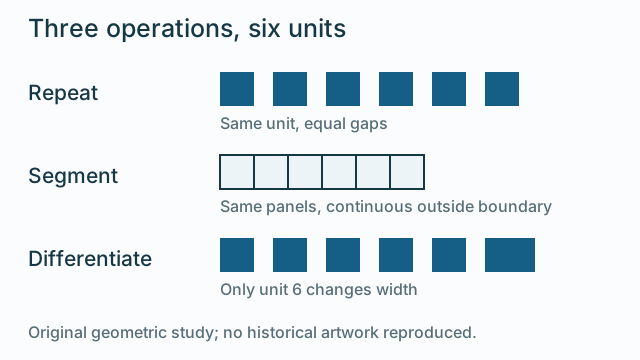
Draw six equal squares in a row with equal gaps. Keep the unit, orientation and spacing constant. The first row of the diagram fixes that baseline; changing only the gaps would change rhythm while leaving the squares themselves unchanged.
Apply that distinction to the study’s references to trails and snake-like forms. The reading task is to identify a candidate unit and a rule of placement, rather than to stop at a resemblance to an animal.
Segmentation: where does one part end?
Bring six equal square panels edge to edge within one continuous rectangular outline. The middle row keeps the same six panel sizes as the first row; it changes their joining and the status of the outside boundary. Six separate units and a whole divided into six parts have the same count, but different constructions.
For a curved form, mark the joints separately from the overall path. This lets you ask whether the curve follows from changing relations between parts or from the outline of an undivided body. The question is structural, even when the first impression is a familiar silhouette.
Differentiation: which change matters?
Return to the row of squares and make only the final square wider. A sequence remains recognisable while one part acquires a distinct role. Now try changing its colour instead of its width. These are different kinds of difference: one changes geometry, the other changes appearance.
A differentiated part need not have a demonstrated function. If you propose that a wider end should provide support, that is a design hypothesis to test, rather than a result supplied by the drawing.
A leg-bearing unit makes the distinction visible
The Field Museum’s Milli-PEET introduction distinguishes one pair of legs per centipede body segment from two pairs on most millipede segments. “Most” matters: a repeated body plan need not make every visible part identical.
For this formal comparison, the candidate unit is a leg-bearing segment; the relation is the succession of those units along a body. A joint between successive parts is a division. A differently shaped end is differentiation. None of those observations tells us how a robot joint should be driven. A mechanism would require its own account of motion and material.
The natural example gives the historical comparison a specific unit and rule. The six geometric units above remain deliberately simpler: they isolate one operation at a time.