
A Blog About Technology Begins Away from the Screen
A news link waits in a favourites folder. An RSS reader waits to be opened. Neither arrangement guarantees a moment in which its owner can read. In the recovered index of Anjali Arora’s blog, the attraction of audio begins with that ordinary gap between collecting information and making room for it.
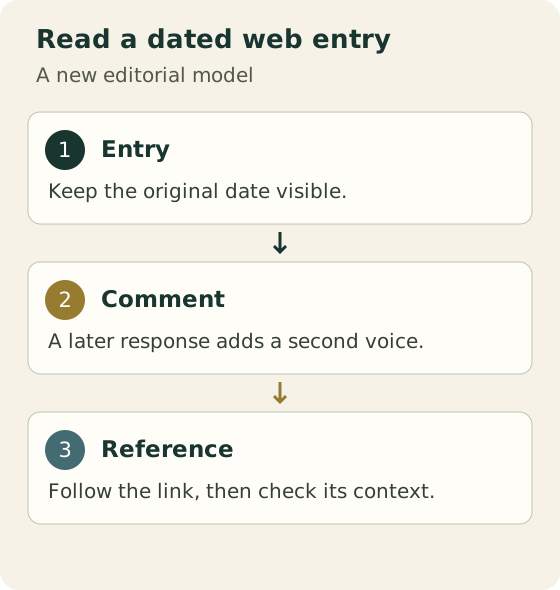
The June 2007 capture contains entries visibly dated June and July 2005. In the post on podcasts, Arora describes trying BBC audio on dial-up and valuing the ability to listen while carrying on with other activities. Another entry connects convenience foods with changing household practices and family expectations. The archive preserves those personal accounts; it supplies no general study of attention or technology adoption.
Availability is only the first step
An interface can make a document easy to save while leaving it difficult to use. The saved item still needs a place in someone’s day. This is a useful question to carry from the blog into present design work: what happens after the reassuring click that says the information has been kept?
Consider an invented example. A local history group sends a ten-minute account of a neighbourhood walk. One member wants the full account at a desk. Another wants to hear it before visiting. A third needs one address while already outdoors. They share an interest without sharing a reading situation.
A useful service would let them choose the full text, audio and a concise location note. Adding three formats would not by itself establish success. The address must remain findable, the recording must identify its subject, and the text must offer a route back to the sources.
Do not confuse a habit with a defect
A person who leaves an aggregator unopened has not necessarily failed to understand it. Their circumstances may make another activity easier to sustain. Equally, a convenient format for one person can impose a new obstacle on someone else.
Map the example before judging it. Where is the person? What are they trying to finish? Which part requires their eyes? What can they postpone? These questions are more informative than a universal demand for less friction. Sometimes the important act is choosing what deserves uninterrupted attention.
Read an early blog as a set of encounters
The index moves between household experience, design questions, city life and linked arguments. Its entry on search and hierarchy contains substantial quotations from other writers. A careful reader must follow those attributions rather than treating every paragraph as Arora’s own argument.
I find the personal encounters the strongest starting point: a folder nobody opens, an audio item that finds a place in a day. They turn a broad claim about technological change into a question someone can examine.
This new editorial guide links the historical index and develops an independent example. It neither republishes the old blog nor presents its author’s 2005 experiences as current recommendations or research results.
Sources and edition
This is a new editorial reading based on the cited records. The archived pages and artworks remain at their sources; this edition does not claim to reproduce their original bytes or operate their old services.