
The Pot Is an Object; the Reflection Is an Event
A pot is easy to name. The light returning from a counter is harder to hold still in language. In Anjali Arora’s archived still-life description, the earthen vessel matters together with morning illumination and reflections from granite. The subject is an arrangement of relations, rather than an inventory of household things.
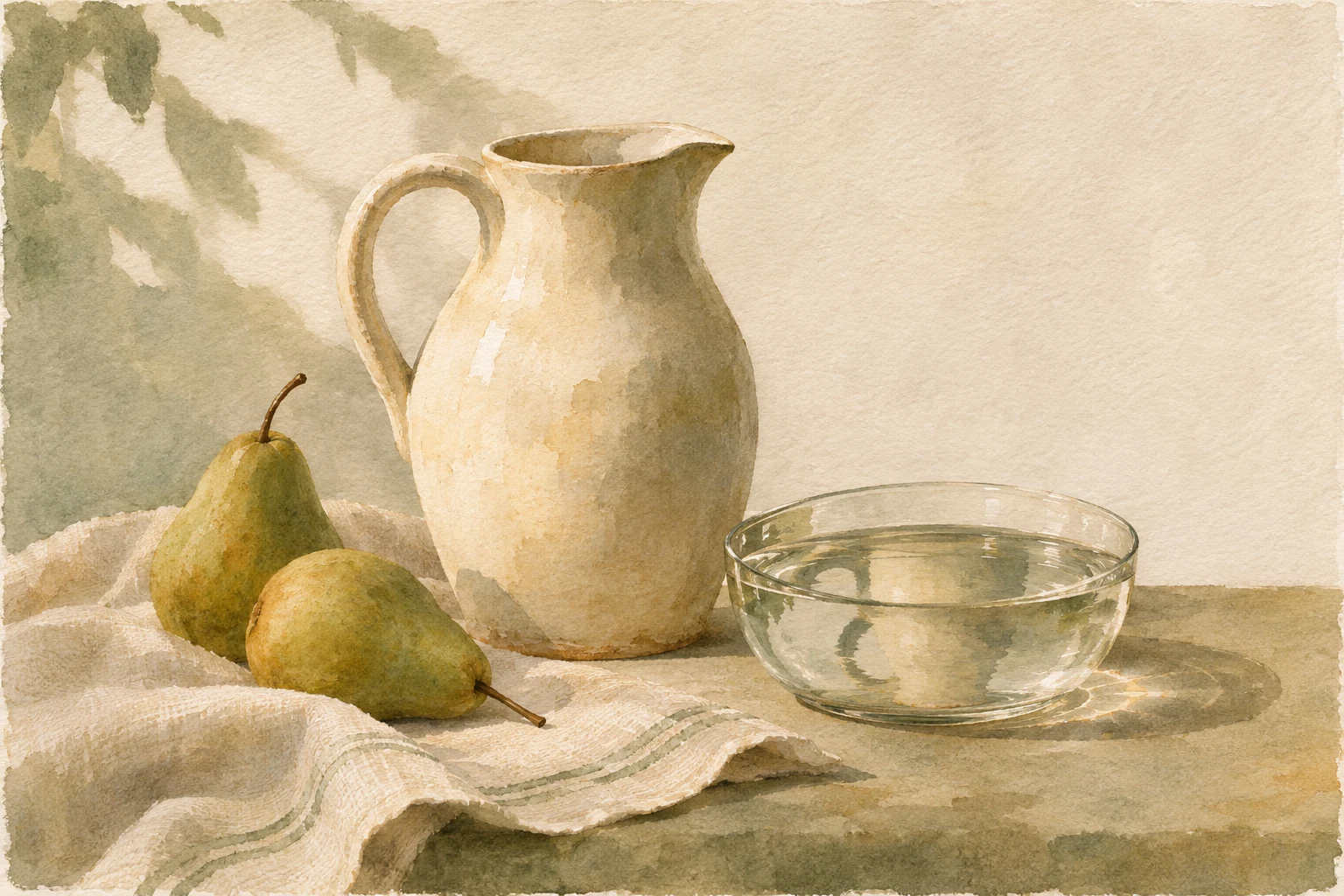
The historical gallery discusses warm reds and browns in Flowers in Glass, an earthen pot in Pot of water, and a blue-and-white bowl with lemons against a black surface. Those are the artist’s descriptions. The reading here examines that written account; it does not claim a fresh visual inspection of the associated original paintings.
Separate the object from what happens around it
The pot remains the same kind of object when the light changes. Its visible relation to the counter does not. That difference provides a concrete question for looking at any still life: which parts of what you see belong to an object’s boundary, and which depend on this particular arrangement?
Try a new observation exercise with an ordinary plain cup on a table. Before moving anything, make two short lists. The first names forms and positions. The second describes light and dark areas without assuming which object they belong to.
A dark patch might be an opening, a cast shadow or part of the background. Naming the cup will not settle that question. The separate lists slow the jump from recognition to explanation.
Give colour a relation, not only an adjective
Warm and cool are useful comparisons when the compared areas are clear. They become vague praise when attached to an entire picture without distinction.
For the cup exercise, describe one area beside another: a pale rim against a darker interior, a reflected patch beside a matt surface. Then write what changes at their meeting. Does the boundary become easy to follow? Does one area merge with its surroundings? These are questions to inspect, not effects guaranteed by particular colour names.
The archived gallery’s account of contrasting objects and surfaces supplies a reason to ask them. It does not supply your answers for a different arrangement.
A controlled setting still contains a choice
Control does not mean that every part of a composition should receive equal attention. Choosing the space between two objects can matter as much as choosing the objects themselves. A reflection can draw attention away from the thing that produced it.
I would begin by asking what the arrangement makes difficult to separate. That is often where a still life becomes more interesting than its list of subjects. A vessel, a surface and a light can offer several competing edges to follow.
This new editorial exercise accompanies a historical source link. Its cup example is independently invented. It neither reproduces the paintings nor claims an artist-approved lesson, a reconstruction of their setup or a current offer to sell the works.
Sources and edition
This is a new editorial reading based on the cited records. The archived pages and artworks remain at their sources; this edition does not claim to reproduce their original bytes or operate their old services.