
A City View Changes When the Small Structure Matters
A small section of yellow stone interrupts many greens. In the written account of Greenery, Anjali Arora identifies that contrast as a decision: the temple supplies an architectural counterpoint to a balcony view full of organic shapes.
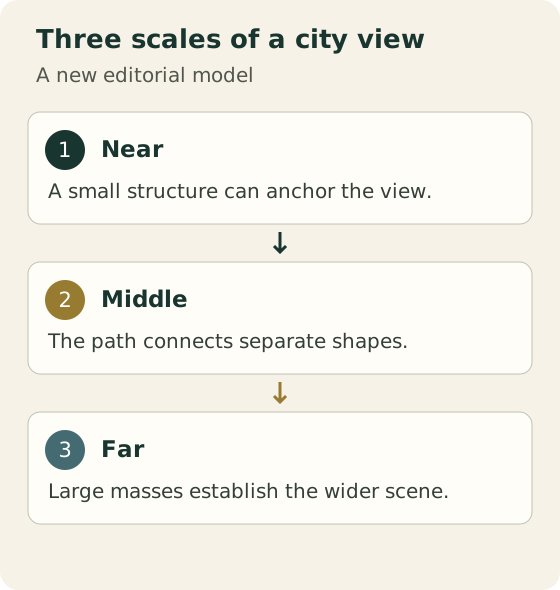
The archived townscape gallery also connects Clothes Bazaar and Street Scene,Ahmedabad with busy streets, Fields with clouds with seasonal changes, and Road to Shela with an arching path through trees. These are the artist’s descriptions. This study reads those accounts; it does not pretend that the original paintings have all been visually examined in this recovery pass.
Scale can give a small element a large job
A small structure need not be a minor event in a composition. Its difference from what surrounds it can make it conspicuous. An orderly edge among irregular forms offers a different point of attention from another patch of similar texture.
Make a new, deliberately abstract exercise. Arrange three uneven green shapes on a page. Add one small warm rectangle. In a second version, make the rectangle twice as large; in a third, move it to the edge. Keep the other shapes unchanged.
Compare what happens to your first point of attention and to the gaps between forms. The exercise does not recreate Greenery. It isolates a question suggested by the author’s account: how much work can a small contrast do?
A place name does not explain the picture
Knowing that a scene concerns Ahmedabad gives it a geographical context. It does not explain how the work organizes a street. A crowded market may be described through repeated figures, compressed spaces, directional marks or the relation between buildings and open areas. Those possibilities need evidence from the particular picture.
Keep three kinds of note separate. A source note records the identified place. A descriptive note identifies visible relations when an image is available. An interpretation explains why those relations matter to your reading. Missing visual evidence should not be replaced by a plausible story about the city.
Return to the same view with a different question
The gallery’s interest in seasonal change offers another route. A repeated view need not be a repeated picture: growth, light and activity can reorganize the same location.
For an observation journal, choose one ordinary view and record it at two times. Describe what remains fixed before listing what changes. Do not assume a particular season must produce a particular mood. A change becomes useful when you can point to its effect on the arrangement.
I find the small architectural interruption a stronger beginning than a broad claim about the energy of urban life. It gives looking something specific to test.
This independent editorial study links the historical gallery and adds a new geometric exercise. It does not reproduce the original paintings, claim a documented route through Ahmedabad or present the former artist’s address and circumstances as current information.
Sources and edition
This is a new editorial reading based on the cited records. The archived pages and artworks remain at their sources; this edition does not claim to reproduce their original bytes or operate their old services.