
A Portfolio Needs More Than a List of Skills
Interaction designer, user experience designer, information architect: the three descriptions on Anjali Arora’s archived design homepage overlap, but they invite different questions. What did she make? Which part was hers? What can a reader inspect?
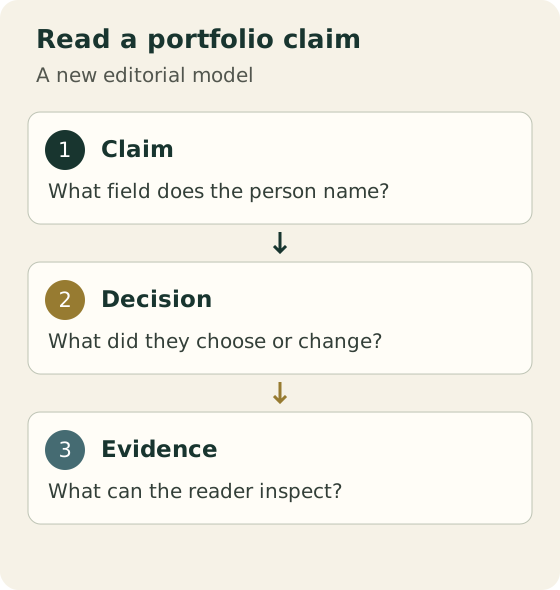
The page presents consulting alongside the development of her own web applications and mentions an initial social-networking prototype. A linked portfolio account describes information-architecture work for Cancer.com: successive sitemaps and wireframes, personas, and an organization combining audience with the disease lifecycle. It also acknowledges limited knowledge of how the principal audiences sought information. The August 2015 archive dates these surviving pages; it does not date every project or verify later outcomes.
Give the reader a claim they can examine
A portfolio label establishes an area of practice. A project account becomes useful when it identifies a decision. Audience and stage, for example, are two organizing dimensions. Putting them together is a choice a reader can question rather than a skill they must accept on trust.
Here is a new comparison, unrelated to medical information. Imagine a community workshop containing materials for newcomers, volunteer facilitators and repair-session organizers. Each person may also be preparing, attending or following up. Sorting only by role can bury the next action. Sorting only by stage can mix instructions intended for different responsibilities.
Draw both arrangements using the same six invented document titles. Where would a newcomer find the first-session checklist? Where would a facilitator find the attendance note? Do not call one structure better until the questions and expected destinations are written down.
Keep uncertainty beside the decision
The most useful detail in the archived case is the admission about audience knowledge. A sitemap can look settled while the assumptions beneath it remain provisional. An honest project account lets the reader see both.
For the workshop example, distinguish three statements: we chose role-first navigation; we expect newcomers to recognize that label; a participant found the checklist. The first describes a decision, the second a hypothesis, and the third an observation requiring an actual session. Attractive documentation cannot turn one into another.
An informative portfolio would place the question, proposed structure and evidence close together. It would also say which work belonged to the designer and which depended on a client or team.
Read across projects without inventing a career
The historical homepage gives a route into a body of work, rather than a licence to fill in its missing years. Prototype means prototype. A consulting role does not establish ownership of the whole product. A school affiliation does not make the school an endorser of this edition.
I would start with the specific organizational choice, then follow the linked record. That gives the portfolio a readable centre: decisions with consequences a reader can discuss. This is a new editorial guide to that reading task, not Arora’s current professional profile or a recovered offer of services.
Sources and edition
This is a new editorial reading based on the cited records. The archived pages and artworks remain at their sources; this edition does not claim to reproduce their original bytes or operate their old services.