
A Sitemap Chooses Who Arrives First
Put audience first and the first question is who you are. Put disease stage first and the question becomes where you are in a process. The archived Cancer.com case chooses a hybrid rather than pretending the two questions are interchangeable.

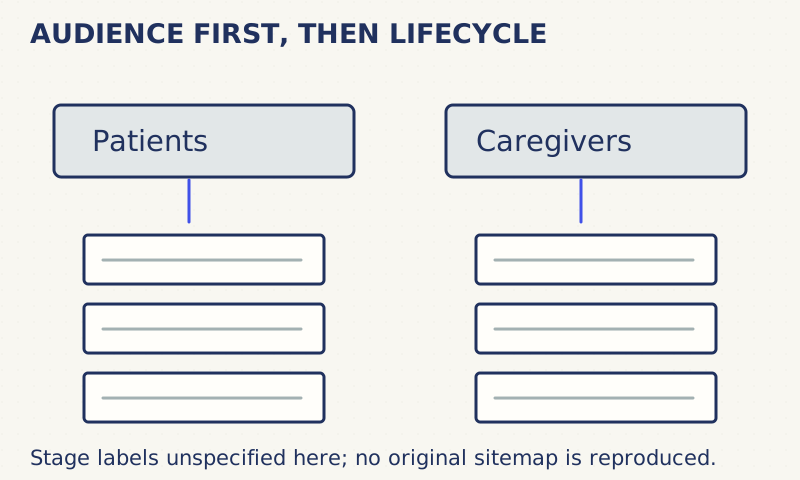
Content and objectives arrive before the diagram
In the portfolio account captured on 20 August 2015, Anjali Arora identifies her role as information architect within a team. The client had existing content and business objectives. The recorded work includes several iterations of sitemaps and wireframes in Visio, together with personas.
Those details put constraints around the drawing. The structure had to make use of a particular content bank while serving more than one audience. This is not an empty diagram later filled with interchangeable pages.
One hierarchy gives two dimensions an order
The account names patients and caregivers as the principal audiences and says little information was available about how they sought information online. It considers organisation by cancer type and by lifecycle. The initial choice puts audience first, then lifecycle within it.
The order has a consequence. A person must recognise an audience label before encountering the next division. The same stage may be relevant from more than one audience route; a hierarchy alone does not make that shared relationship visible. This is an interpretation of the chosen arrangement, not evidence of a reader failing to navigate it.
Cross-links loosen the branch
The source also calls for simple navigation with ample cross-linking. Read beside the hybrid hierarchy, that is a useful qualification: entering through one branch need not imprison a reader there. A link can carry a relation that the first division cannot express.
The surviving written account does not provide a measured outcome, a complete test protocol or a current medical-information service. Its value here is more precise: it names an organising decision and the uncertainty under which it was made. The current six-resource model makes the separate problem of one shared timetable inspectable with fully listed data.
Record note
Historical project and role account: Anjali Arora, linked source above. This page is new independent criticism at the old /web.htm address. It does not reproduce the portfolio, recover its original sitemap or offer medical guidance. Return to the design-portfolio introduction.