
A Silent Sonar Reading: Separate the Pulse from the Number
A zero in a serial window can look precise while saying very little. Did the sensor hear no echo? Did the controller miss a pulse? Did a conversion produce the displayed value? The useful task is to keep those possibilities separate.
The recovered student page identifies the Devantech SRF04 ultrasonic ranger. It describes an initially unresponsive setup and a later response after code changes, discussing clock configuration and the move from an analog-configured port to another port. That is the group’s account, not an isolated demonstration of one cause. An associated code file survives, but has not been compiled or run for this edition.
First identify the instrument
SRF04 matters as a model name. A familiar-looking pair of transducers is not sufficient reason to substitute instructions for a different module.
The manufacturer’s SRF04 documentation describes a trigger and an echo pulse whose width represents travel time. Its centimetre conversion divides microseconds by 58. It also describes timeout behaviour and revisions to the module. These details establish a source to consult; they do not verify the wiring or timing of an unidentified board in a photograph.
Keep three stages visible
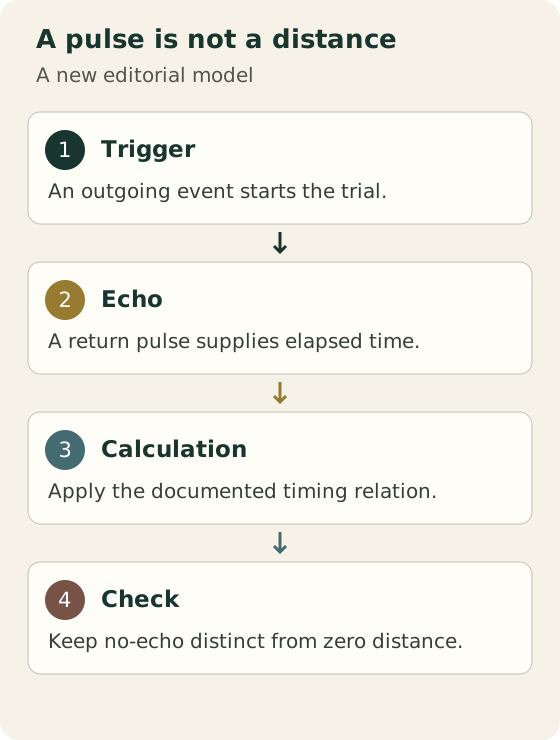
Consider a new paper model of a ranging system. One box requests a measurement. A second records an incoming duration. A third converts the duration into a distance. Give each box its own observation instead of drawing one unexplained arrow from sensor to number.
For an invented received pulse of 580 microseconds, the documented conversion gives 10 centimetres. That arithmetic checks the conversion example only. It cannot establish that a physical pulse was received, that the timer measured it correctly or that an actual object was 10 centimetres away.
Now give the paper model a timeout marker. Do not pass that marker through the same calculation and display it as an ordinary measured distance. A missing observation and a measured value need distinguishable representations.
Let a change remain a candidate explanation
When software configuration and port selection both change, a later response does not identify their separate effects. A useful account records what changed, the expected effect of each change and what was actually observed.
The same discipline helps when reading an old project. A report can establish that its authors changed a setting and saw a response. A stronger causal claim would need a comparison that holds other relevant conditions steady. The surviving account should not acquire that comparison through editorial tidying.
I find this a more useful lesson than turning the page into a current breadboard recipe. A sensor reading is a small chain of claims: identification, signal, timing and interpretation. Each link deserves its own evidence.
This independent study is a historical reading and a paper example. It supplies no tested circuit, approved pinout, measured sensor performance or reproduced hardware result.
Sources and edition
- Student SRF04 research page, capture 4 December 2011
- Associated code2 text, capture 23 December 2004; not run
- SRF04 manufacturer technical documentation, checked 4 November 2026
This is a new editorial reading based on the cited records. The archived pages and artworks remain at their sources; this edition does not claim to reproduce their original bytes or operate their old services.