
One Glowing LED Does Not Explain a Whole Circuit
An indicator lights. The intended output stays dark. The gap between those two observations gives this physical-computing journal its useful centre.
The small success does not explain the whole board
The Spring 2004 journal identifies a course with Tom Igoe. Anjali Arora records early LED exercises and a digital-output difficulty associated with a reset connection. The indicator and the intended output are different parts of the account. Making them one statement—“the circuit works”—would remove the distinction that makes the fault readable.
The record later turns to serial-output problems and an overheating regulator. Its questions remain unfinished on the page. That unfinished record is useful: the reader can see where an observation stops and an explanation has yet to begin.
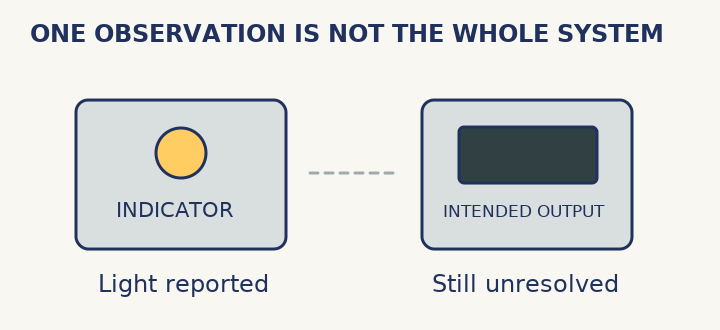
Another system has to work at the same time
The Chinese Checkers concept explores competing media organisations. Its question is not exhausted by whether a component responds. Players following a game also have to notice a surrounding flow of information. Electronics can perform their assigned operation while that proposed encounter still divides attention awkwardly.
The journal thus keeps two kinds of uncertainty together. One concerns a technical path from signal to output. The other concerns the relation between a participant’s task and the meaning the work hopes to communicate. Neither becomes solved merely because a lamp lights.
Let the process keep its rough edge
The final-project description names Window to the world. Read beside the earlier entries, it belongs to a process that includes proposals, partial responses and unresolved faults. The unresolved entries show how much can remain unknown between a first response and a finished work.
The separate SRF04 reading follows one narrower chain: request, pulse duration, conversion. Both readings concern historical reports, rather than construction instructions or experiments repeated by this edition.
Source
Physical-computing journal, captured 21 July 2011. The course belongs to Spring 2004; the capture is later.